Reserve
your unit
today!
your unit
today!
 wonderproperties3@gmail.com
Wonder Properties © All rights reserved
Privacy PolicyPowered bykarimcgvisuals
wonderproperties3@gmail.comWonder Properties © All rights reserved
Privacy PolicyPowered bykarimcgvisuals
Blog | October 5, 2026
When a Sh2 trillion-plus industrial project takes shape hundreds of kilometres from Nairobi, why should property investors in the capital pay attention?
Kenya's property market is often analysed through what happens within Nairobi's major real-estate corridors — Westlands, Kilimani, Riverside, Upper Hill, Karen and the growing satellite towns. But sometimes, the forces shaping Nairobi's property market begin much further away.
The planned Dangote East Africa Oil Refinery in Lamu could be one of those forces.
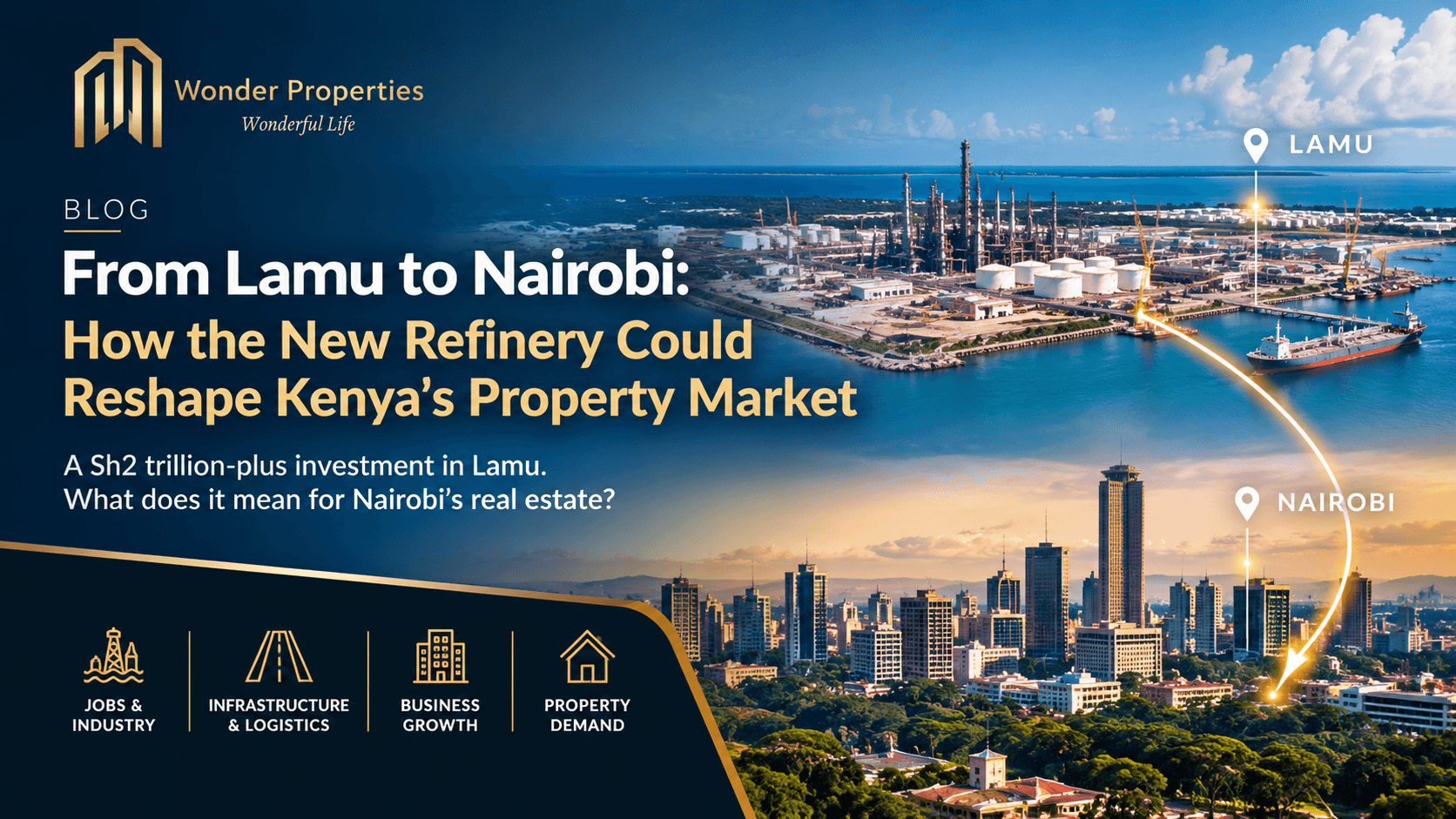
Following its groundbreaking on September 30, 2026, the proposed refinery has put Lamu at the centre of one of Kenya's biggest industrial investment stories. The project is planned to have a processing capacity of 700,000 barrels of crude oil per day, with completion targeted around 2030. Reuters reports the investment at approximately US$16 billion, making it one of Kenya's largest foreign investments.
At first glance, this looks like a Lamu story. For Kenya's property market, however, the implications could stretch much further.
Large industrial projects rarely create demand in only one sector. A refinery of this scale requires engineering, logistics, financial services, technology, construction, insurance, legal services, hospitality, transportation and a wide network of suppliers.
Business Daily reports that engineering and technology firms have already secured contracts worth more than Sh100 billion connected to the project, while the wider development is expected to create approximately 60,000 jobs.
The refinery is also expected to anchor a wider industrial ecosystem around Lamu, including petrochemicals and related industries. That matters for real estate because economic activity creates people, businesses and movement — and people and businesses require space.
Lamu is likely to feel the most direct property impact, particularly through demand for housing, accommodation, retail, logistics and commercial facilities.
But Nairobi could become an important secondary beneficiary.
Nairobi remains Kenya's principal corporate, financial and professional-services centre.
Even when major industrial activity happens outside the capital, many of the companies supporting that activity may continue to operate their headquarters, financial functions and professional teams from Nairobi. That creates a potential connection between industrial growth in Lamu and commercial activity in Nairobi.
As businesses participate in the refinery and the wider LAPSSET ecosystem, demand could emerge for:
I. Corporate offices
II. Executive accommodation
III. Serviced apartments
IV. Short- and medium-term corporate housing
V. Hotels and hospitality
VI. Conference and business facilities
VII. High-end residential property
This does not mean the refinery will immediately push Nairobi property prices higher. Instead, it creates another potential source of long-term demand for specific segments of Nairobi's property market.
Perhaps the bigger story is not the refinery alone. It is the infrastructure and economic corridor around it. The refinery is planned within the Lamu Port-South Sudan-Ethiopia Transport (LAPSSET) Corridor, leveraging Lamu's deep-water port. The project is intended to serve Kenya and wider regional markets, while supporting storage, logistics, petrochemicals and manufacturing around the facility.
If this ecosystem develops successfully, Lamu could increasingly function as an industrial and logistics gateway. Nairobi, meanwhile, could continue to serve as the corporate and financial command centre behind some of that activity. This creates an interesting real-estate relationship:
Lamu → Industrial activity → Jobs & businesses → Regional trade → Corporate services → Nairobi demand
It is a long chain, but property markets often respond to precisely these economic connections.
One segment worth watching is serviced and executive accommodation. Major infrastructure and industrial projects often bring consultants, executives, contractors, engineers and business visitors into the country for extended periods. Some may need accommodation in Lamu or along the Coast.
Others may spend part of their time in Nairobi for meetings, financing, procurement, professional services and corporate operations. That could support demand for well-located serviced apartments and high-quality residential accommodation in established business districts.
For Nairobi developers, the lesson is not necessarily to build more units simply because a refinery is coming. It is to understand who the next wave of economic activity could bring into the city and what type of accommodation they will require.
Commercial real estate could also be part of the story.
As new businesses enter Kenya or existing companies expand to participate in emerging opportunities around Lamu and LAPSSET, they may require offices and support services. This comes at an interesting time for Nairobi's property market.
The city is already experiencing a shift in the types of developments attracting investor attention, with commercial and mixed-use projects becoming increasingly important in several locations.
The refinery could add another layer to this demand — particularly if it contributes to sustained growth in logistics, energy, manufacturing and regional trade.
It is important not to overstate the impact.
The refinery is still a project under development, with completion targeted around 2030. It also faces challenges, including questions around crude supply, infrastructure and ongoing legal disputes concerning land at the proposed site. That means investors should distinguish between potential economic impact and confirmed property-market performance.
There is currently no basis to say that the refinery itself will cause Nairobi property prices to rise.
The more reasonable question is:
What happens if the refinery succeeds in attracting the wider industrial ecosystem that has been envisioned around it?
That is where the real estate implications become much more interesting.
For property investors, this means looking beyond the building itself.
Where are the jobs going? Where are businesses moving? Which infrastructure is being built? Which industries are emerging? And where will the people supporting those industries live and work?
Those questions can sometimes tell us more about the future of property values than today's asking prices.
The Lamu refinery is therefore more than an energy story.
It is potentially a story about jobs, infrastructure, logistics, regional trade, business expansion and urban development. And while its most immediate property impact may be felt in Lamu and the Coast, Nairobi should not be ignored.
If Kenya succeeds in building a new industrial and logistics ecosystem around Lamu, the economic benefits could travel well beyond the refinery gates. For Nairobi's property market, the opportunity may not be in the refinery itself.
It may be in everything the refinery brings with it.
As Kenya moves towards 2030, the property market may increasingly be shaped not only by what is being built in Nairobi, but also by the economic corridors being built around it.