Reserve
your unit
today!
your unit
today!
 wonderproperties3@gmail.com
Wonder Properties © All rights reserved
Privacy PolicyPowered bykarimcgvisuals
wonderproperties3@gmail.comWonder Properties © All rights reserved
Privacy PolicyPowered bykarimcgvisuals
Blog | September 23, 2026
If you're comparing different developments, use the same measurement basis wherever possible. For example, comparing the net area of one apartment against the gross area of another won't give you a meaningful comparison.
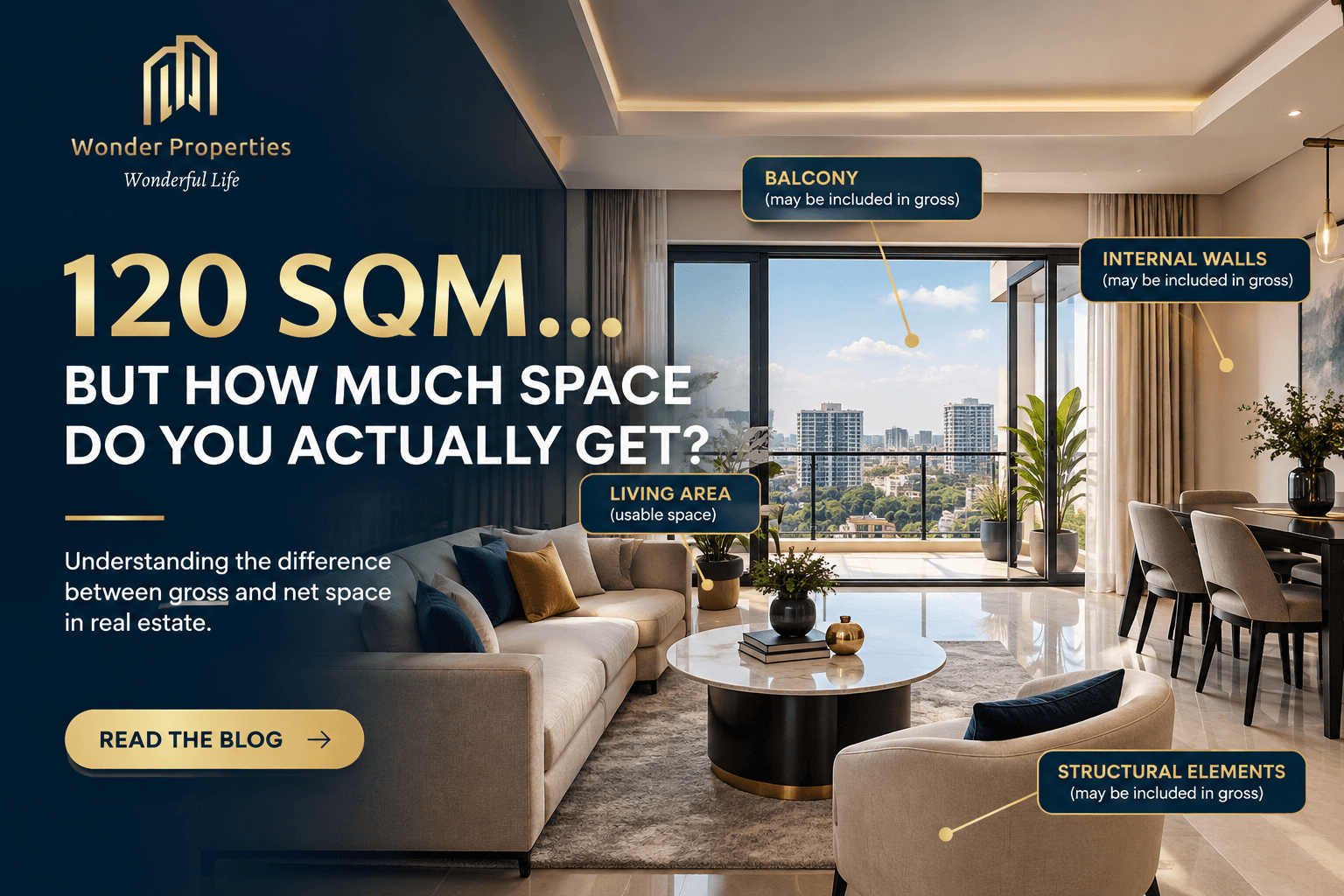
When shopping for an apartment, one of the first questions buyers often ask is: “How many square metres is the apartment?” You might see a property advertised as 120 sqm, 150 sqm or even 200 sqm. But what exactly does that figure represent?
Understanding the difference between gross space and net space can help buyers make better comparisons and understand exactly what they are paying for.
Gross space generally refers to the larger measured area associated with a property before certain deductions are made.
Depending on the developer's measurement and sale agreement, the figure may account for elements such as internal walls, structural elements, balconies or terraces and, in some cases, a proportionate share of common areas.
This means an apartment advertised as 120 sqm gross does not necessarily mean you have 120 sqm of unobstructed, usable floor area. The exact definition can vary, which is why buyers should always ask the developer what is included in the quoted figure.
Net space generally refers to the area that is actually available for use within the property, after excluding certain elements such as walls and structural components.
Think about the rooms you actually live in: your living room, bedrooms, kitchen, bathrooms and other usable internal areas.
For a buyer, this measurement can provide a clearer picture of the space available for everyday living.
Consider two apartments:
Apartment A: 120 sqm gross
Apartment B: 105 sqm net
At first glance, 120 sqm may appear to be the larger apartment. However, the two figures are measuring different things.
This is why comparing apartments based only on the headline square-metre figure can sometimes be misleading.
Instead, buyers should ask:
i. Is the quoted area gross or net?
ii. What is included in the measurement?
iii. Are balconies or terraces included?
iv. Are internal walls included?
v. Does the figure include a share of common areas?
vi. What does the approved floor plan show?
vii. What is the actual usable floor area?
Buyers may also come across terms such as saleable area, chargeable area or gross floor area.
These terms can have different meanings depending on the development, market and documentation. A chargeable or saleable area may incorporate the apartment itself together with certain other components used by the developer when determining the property's price.
Therefore, don't assume that two developers using the same number of square metres are necessarily measuring the same thing.
Always ask what the quoted area represents.
Imagine an apartment advertised as 150 sqm.
That figure could include the internal apartment area together with walls, balconies or other components, depending on the measurement methodology. The actual usable space could therefore be lower than the advertised figure.
The important question isn't simply:
“How many square metres is it?” It is: “How were those square metres calculated?”
Before committing to an apartment, ask the developer or sales team to explain the property's measurement clearly.
Request the floor plan and relevant area schedule, and ask them to identify the net usable area, gross area and any other areas included in the quoted figure.
You should also check the sale agreement and other official project documentation to understand how the property is defined and priced.
If you're comparing different developments, use the same measurement basis wherever possible. For example, comparing the net area of one apartment against the gross area of another won't give you a meaningful comparison.
Square metres are important—but what those square metres represent is even more important.
Understanding gross and net space allows buyers to look beyond the headline figure and evaluate the actual space they are getting.
So the next time you see an apartment advertised as 120 sqm, don't stop at the number.
Ask:
“Is that gross or net—and what exactly is included?”
Because when buying property, knowing the space you're paying for is just as important as knowing the price.
Looking for a home that combines thoughtful design, functionality and quality? Explore the developments by Wonder Properties and discover spaces designed around modern living.