Blog | August 1, 2026
You Bought the Property. Now What? Why Property Management Is Becoming Do-or-Die for Investors and Buyers
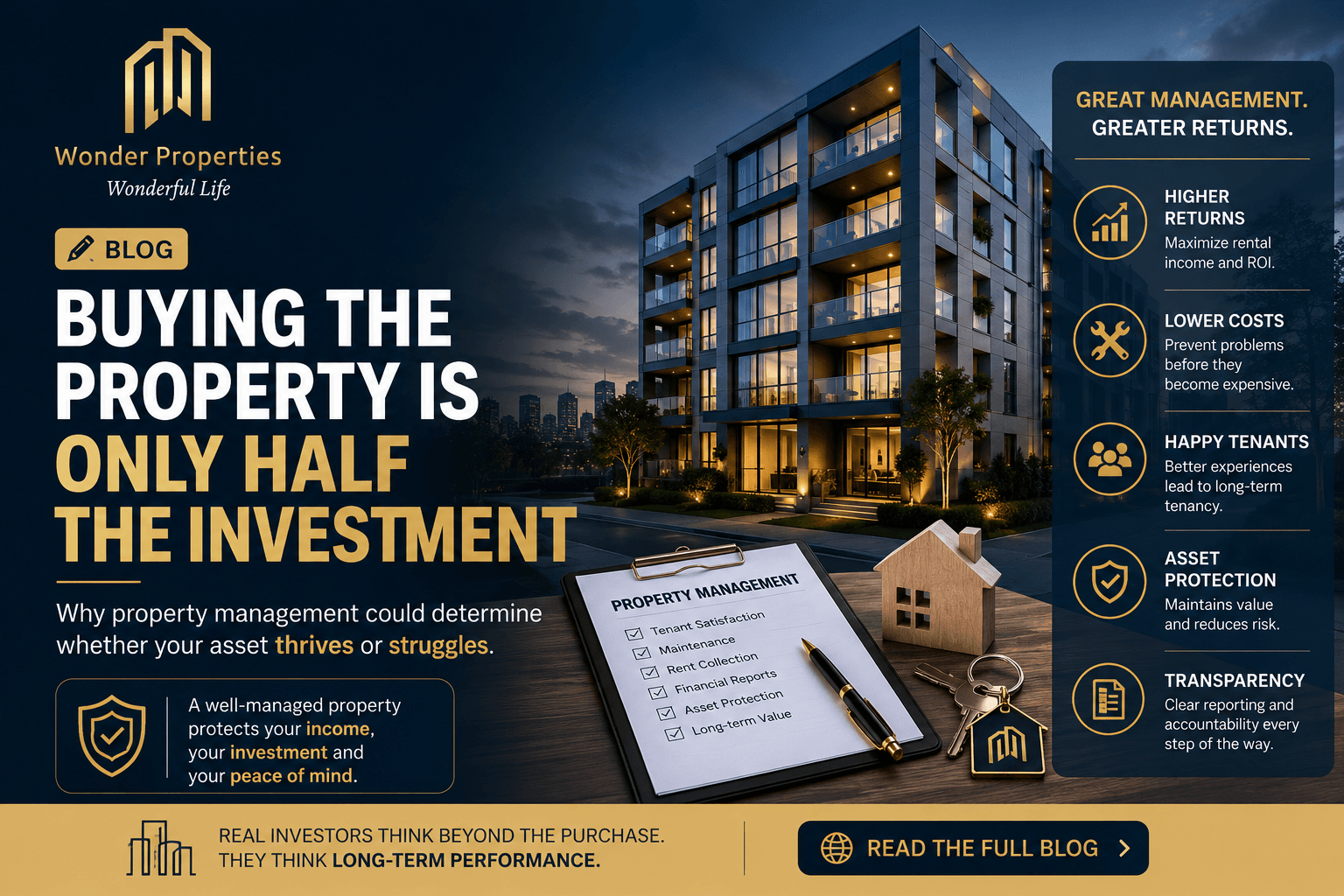
Property management is no longer simply an administrative function sitting quietly in the background. For today's property investor, it can be the difference between owning an asset and owning an asset that actually works for you.
For years, the real estate conversation in Kenya has largely revolved around one question:
“Where should I buy?”
Should you buy in Westlands? Kilimani? Riverside? Kileleshwa? Ruaka? Should you go for a one-bedroom apartment, a two-bedroom, a serviced apartment or a commercial unit? These are important questions. But there is another question that is becoming just as important—and perhaps even more important once you have signed on the dotted line:
“Who is going to manage the property?”
Because buying property is one thing. Making that property perform is another. A beautiful apartment can lose its appeal. A well-located development can develop maintenance issues. A property can have excellent amenities on paper but poor service delivery in reality. Tenants can leave, rent collection can become inconsistent, service charges can be poorly managed and small maintenance problems can eventually become expensive repairs.
This is why property management is no longer simply an administrative function sitting quietly in the background.
For today's property investor, it can be the difference between owning an asset and owning an asset that actually works for you.
Property ownership doesn't end at handover
There is often a psychological shift when an investor receives the keys to a property.
The construction is complete. The title or ownership documentation is in place. The apartment is furnished—or ready to be furnished. The investor feels that the hard part is over.
In reality, another phase has just begun. The property now needs to be occupied, maintained, protected and managed.
If it is a rental property, tenants need to be sourced and retained. Rent needs to be collected. Maintenance requests need to be addressed. Common areas need to remain clean and functional. Security needs to be maintained. Amenities need to work. Service providers need to be coordinated. Financial records need to be kept.
And all of this has one underlying objective: Protect the value of the asset while helping it generate income.
That is property management.
The hidden side of your property's return
When investors talk about returns, the conversation usually starts with purchase price and expected rental income.
For example:
You purchase an apartment for K Sh 10 million and expect it to generate K Sh 70,000 per month. On paper, the numbers look straightforward.
But what happens when the unit sits vacant for three months? What happens when a tenant leaves because maintenance requests take too long to resolve? What happens when a leaking pipe is ignored until it damages walls, cabinetry or flooring?
What happens when service charges are poorly managed and common areas begin deteriorating? What happens when the property's reputation starts declining?
Suddenly, the original return calculation looks very different.
This is why investors should think about property management as part of the investment strategy—not an afterthought.
Your return is not determined only by what you paid for the property. It is also influenced by what happens to that property every day after you buy it.
1. Good property management protects rental income
For an investor, occupancy matters.
A vacant apartment does not stop costing money simply because nobody is living in it. There may still be service charges, financing costs, utilities, maintenance obligations and other expenses. A good property manager therefore does more than collect rent. They help keep the property rent-ready and market-ready.
That includes understanding the target tenant, responding to issues quickly, ensuring the unit is properly maintained and helping minimize unnecessary vacancy periods.
And in a competitive rental market like Nairobi, this matters.
Tenants have options. If one building consistently offers better service, cleaner common areas, functioning amenities and faster responses, tenants may be willing to choose it over another property offering a similar apartment at a similar price.
The property experience can therefore become part of the property's competitive advantage.
2. Maintenance is cheaper before it becomes an emergency
Every property owner knows that maintenance is inevitable. The question is not whether something will eventually need repair.
The question is:Will you address it early—or wait until it becomes expensive? A minor plumbing issue can become significant water damage. A small electrical problem can become a safety concern. A malfunctioning lift can inconvenience an entire building. Poorly maintained landscaping can affect the appearance of an entire development. Property management introduces something extremely valuable to an investor:
proactive maintenance. Instead of constantly reacting to emergencies, a well-managed property should have routine inspections, maintenance schedules, trusted contractors and proper reporting systems.
The objective is simple: Fix small problems before they become big bills.
3. Tenants are not just occupants—they are customers
This is one of the biggest mindset shifts investors need to make. If your property generates rental income, your tenant is effectively part of your investment ecosystem. And tenants today are increasingly conscious of the experience they receive.
They care about security. They care about cleanliness. They care about water reliability. They care about parking. They care about internet connectivity. They care about how quickly maintenance requests are handled. They care about whether the gym, swimming pool, lifts or other amenities actually work. And they care about how management communicates with them. A tenant who feels neglected is more likely to leave. A tenant who has a good experience is more likely to stay. That means tenant experience can influence occupancy, turnover costs and ultimately rental performance.
4. Your property's reputation matters
Real estate may be physical, but its reputation is increasingly digital.
Before renting or buying, people research. They ask friends. They look at reviews. They visit buildings. They compare developments. They speak to existing residents.
A property with poorly maintained common areas, unreliable amenities or unresolved complaints can develop a reputation that becomes difficult to reverse.
And reputation affects demand. Two apartments can be in the same neighbourhood, have similar sizes and even similar asking prices—but attract very different levels of interest because one building is better managed.
The building becomes the brand. That is why property management is also about protecting the reputation of the development.
5. Service charge is not just another bill
For buyers of apartments and other sectional properties, service charge is often viewed simply as an expense.
But what are you actually paying for? Security. Cleaning. Landscaping. Common-area maintenance. Utilities for shared spaces. Repairs. Management.
Insurance and other operational requirements, depending on the development.
Under Kenya's Sectional Properties Act, the corporation of unit owners has responsibilities that include keeping common property in good repair and controlling, managing and administering common property. The Act also expressly provides for engaging a property manager or other persons necessary to ensure the property is well managed.
So the real question should not simply be:
“How much is the service charge?”
It should be:
“What am I getting for the service charge?”
A well-managed building should provide transparency around how shared costs are being used and how those expenditures contribute to maintaining the property's quality.
6. Property management protects the value of your asset
Here's something investors sometimes overlook:
Real estate value is not only about location and square footage. Condition matters. Presentation matters. Functionality matters. Tenant profile matters. Building reputation matters. Amenities matter. Management matters. Imagine owning two identical apartments in the same neighbourhood.
One is in a professionally managed development where the common areas are maintained, security is reliable, repairs are addressed promptly and amenities remain functional. The other is in a poorly managed development where maintenance is constantly delayed and common areas are deteriorating. Even if both properties started with exactly the same purchase price, their future market appeal may not be the same.
Property management therefore contributes to something investors should always be thinking about: capital preservation.
7. It gives investors something money cannot buy: peace of mind
Not every investor wants to become a landlord in the traditional sense. Some investors live in another city. Some live outside the country.
Some have demanding careers. Others own several properties. And some simply do not want to spend their evenings answering calls about leaking taps, rent payments or broken appliances. That is where professional property management becomes particularly valuable.
A good management team can become the operational link between the owner, tenant, contractors and building management. The investor gets visibility without having to personally manage every issue. Your property should create income—not become another full-time job.
8. Technology is changing property management
The days of managing an entire building through phone calls, paper files and scattered WhatsApp messages are gradually giving way to more structured systems.
Technology can now support areas such as: Digital rent collection. Tenant communication. Maintenance requests Financial reporting. Service-charge tracking. Visitor management. Access control. Property inspections. Occupancy monitoring But technology alone is not the answer.
A property management system is only as good as the people and processes behind it. The goal is not to make property management look sophisticated. The goal is to make it more transparent, accountable and efficient.
Property management should actually enter the conversation before you buy, not after.
If you are considering an apartment or investment property, ask:
1. Who will manage the development?
2. How will service charges be determined and managed?
3. Who handles maintenance?
4. How are tenant issues resolved?
5. How are common areas maintained?
6. What happens when an amenity breaks down?
7. How are security and access managed?
8. How are owners kept informed about the property's performance?
9. Is there a clear management structure after handover?
These questions may not sound as exciting as asking about the rooftop pool or the size of the balcony. But they could have a much bigger impact on your experience as an owner.
At Wonder Properties, we believe buying property should be about more than acquiring space. It should be about creating an asset that can stand the test of time.
And as the Kenyan real estate market becomes more sophisticated, investors will increasingly look beyond the walls, finishes and price tag.They will look at the entire ownership experience. Wonder Properties provides that with our exclusive Assets management team.
Because ultimately, a great property is not just one you can buy. It is one that continues to work for you long after you have bought it.
your unit
today!
 wonderproperties3@gmail.com
Wonder Properties © All rights reserved
Privacy PolicyPowered bykarimcgvisuals