Blog | May 21, 2026
The Economics Of Airbnbs In Kenya’s Local Real Estate Market
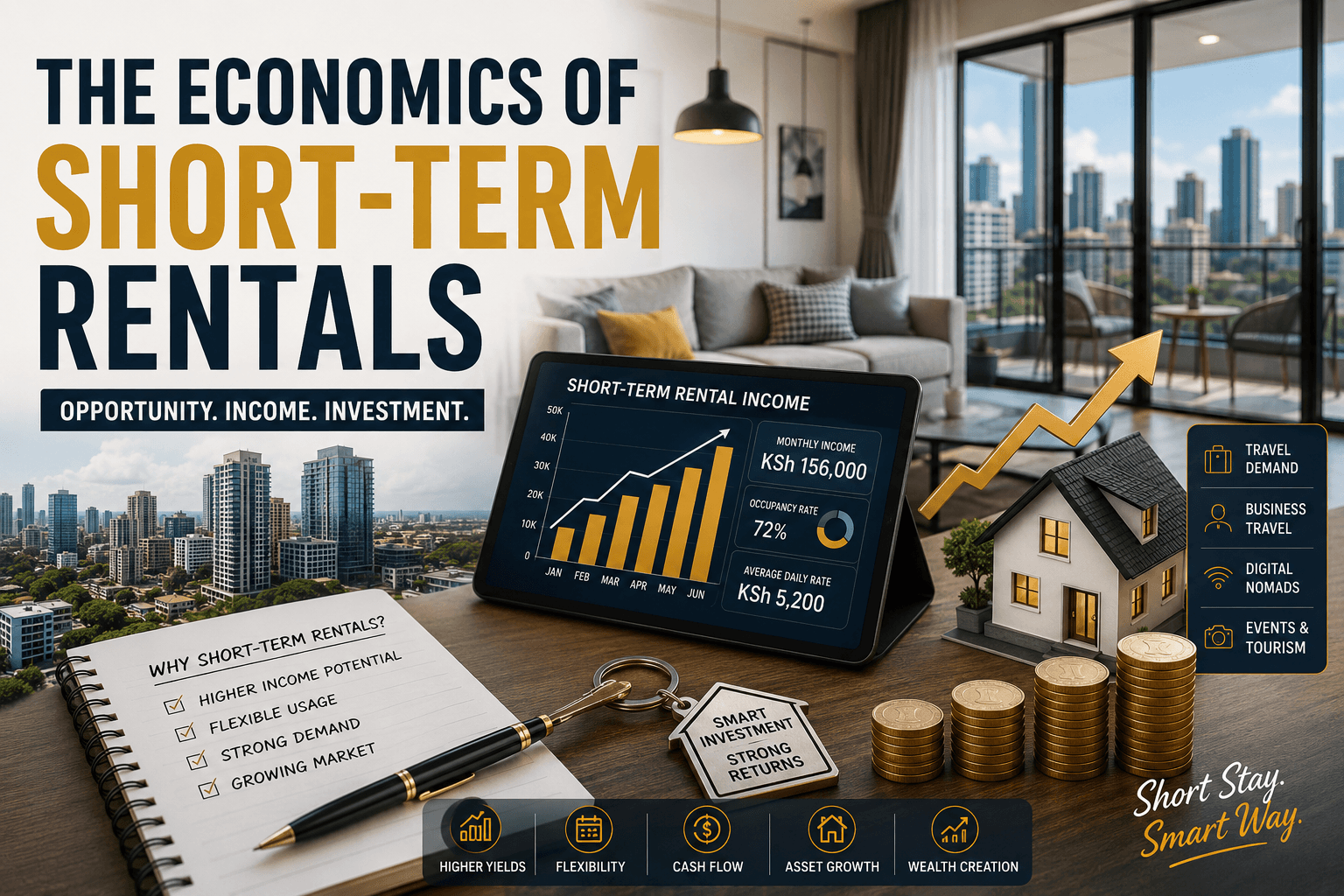
The economics of short-term rentals in Kenya have transformed significantly over the last few years, reshaping investment strategies across Nairobi’s real estate market. From Airbnb apartments in Kilimani and Westlands to serviced units targeting business travellers and digital nomads, short-term rentals are increasingly being viewed as high-yield real estate assets rather than alternative accommodation options.
The rise of short-term rentals (STRs) through platforms like Airbnb has fundamentally changed the economics of real estate in Nairobi. What began as a side hustle for a few furnished apartment owners has evolved into a serious investment strategy influencing pricing, development trends, rental yields, and even housing availability.
Wonder Properties’ Diplomat Residencies is one of the many projects designed and suited for Investors providing excellent returns and future appreciation potential. As an investor you can make a decision on whether to go for long-term or short-term lease agreements. In this article, we will talk about the short-term lease.
Why Investors Are Shifting to Short-Term Rentals
The core reason is simple: higher income potential.
A standard one-bedroom apartment in areas like Kilimani or Westlands may earn between KSh 60,000–100,000 monthly on a long-term lease. The same unit, when professionally managed as a short-term rental, can generate significantly more through nightly bookings.
In Nairobi’s STR [Short-term Rental] market, average occupancy currently ranges between 31% and 44%, depending on location, quality, and management.
The Numbers Behind the STR Boom
Here’s what the economics often look like in Nairobi:
| Factor | Long-term Rental | Short-term Rental |
| Monthly Income | Stable but capped | Higher Potential |
| Tenant Turnover | Low | Very High |
| Furnishing Costs | Minimal | High Upfront Investment |
| Management Intensity | Low | High |
| Vacancy Risk | Lower | Higher |
| Maintenance Costs | Moderate | Frequent |
| Yield Potential | Predictable | Volatile but stronger |
According to recent Nairobi STR market data:
- Active Airbnb listings have grown sharply over the last year
- Supply growth exceeded 50% in some datasets
- Yet demand has remained resilient in prime locations
This indicates that Nairobi is still in a growth phase — though competition is increasing rapidly.
Why Certain Nairobi Suburbs Dominate
Short-term rental economics are highly location-sensitive.
Areas performing best typically offer:
-proximity to business hubs
-security
-lifestyle amenities
-strong road connectivity
-access to diplomatic and corporate zones
Top-performing STR corridors include:
-Kilimani
-Westlands
-Kileleshwa
-Lavington
-Parklands
These areas attract:
-business travelers
-conference attendees
-expatriates
-diaspora visitors
-digital nomads
-medical tourists
This demand has directly influenced developers, many of whom now design apartments specifically optimized for Airbnb use.
The Regulatory Reality in 2026
Kenya’s short-term rental sector has undergone major regulatory changes over the last few years, and the landscape continues to shift rapidly. Investors still relying on the regulatory environment that existed in 2019 or 2020 may be making decisions based on outdated assumptions.
Under the Tourism Act 2011, the Tourism Regulatory Authority (TRA) has increasingly moved to oversee short-term residential rentals being used as tourist accommodation. As a result, Airbnb units and similar furnished stays may now fall under the TRA’s registration requirements, which include inspections, licensing, and adherence to hospitality compliance standards — standards that many residential apartments were never originally designed to satisfy.
At the county level, the Nairobi City County Government has also been exploring regulations targeting short-term rentals. This push has largely been influenced by concerns from resident associations and building management corporations, particularly in high-density suburbs such as Kilimani and Westlands, where long-term residents have raised concerns about the transient nature of Airbnb-style occupancy.
In response, several apartment management bodies have implemented stricter house rules under the Sectional Properties Act 2020. In some developments, these rules either limit or completely prohibit short-term rental operations within individual units. Since such restrictions are legally enforceable against property owners, they can significantly affect the viability of Airbnb investments in affected buildings.
your unit
today!
 wonderproperties3@gmail.com
Wonder Properties © All rights reserved
Privacy PolicyPowered bykarimcgvisuals